
The invitation to change
We tell educators to ask for help, then sometimes treat their questions as evidence that they cannot handle the job. We invite vulnerability, then make it hard to know where private disclosures will travel. We encourage growth, yet confuse visible agreement with genuine commitment.
I have spent 25 years in education, including time as a teacher and school leader. Here is the question I want us to ask: Are we creating conditions where people can grow, or are we simply demanding that they demonstrate willingness on command?
You can require professional responsibilities. You cannot require authentic willingness. That difference is the foundation of this conversation.
Wanting change and feeling safe enough to pursue it
In her October 18, 2026 essay “Yeah, I’m Not Doing That to Get Sober,” educator and recovery writer Jessica Dueñas describes wanting sobriety while initially resisting certain forms of support. She reflects on medication stigma, fear of public disclosure as a teacher, and the work of becoming more willing over time. Importantly, she also recognizes that discomfort may reveal a legitimate safety concern, not merely fear to overcome.
Her essay inspired this inquiry. The Three Conditions framework below, its educator scenarios, and its organizational applications are original BRIAN Corps interpretations, not Jessica’s work or a joint project.
Now extend the question from individual willingness to leadership: What happens when a person wants to grow, but the organization makes the process unnecessarily risky?
What research can, and cannot, tell us
Autonomy support. Slemp, Kern, Patrick, and Ryan (2018) synthesized 72 workplace studies involving 32,870 participants. Perceived leader autonomy support was positively correlated with autonomous work motivation. This is correlational evidence, not a guarantee that any particular leadership intervention will work. [1]
Psychological safety. Edmondson’s (1999) field study of 51 manufacturing teams associated team psychological safety with learning behavior. The study did not test school staff or prove that eliminating disagreement improves performance. Its useful insight for education is that interpersonal risk and learning are connected. [2]
Organizational conditions. The World Health Organization’s 2022 mental-health-at-work guidelines say interventions addressing workplace psychosocial risks may be considered. The universal organizational-intervention recommendation is conditional and based on very-low-certainty evidence. It supports serious attention to conditions without promising a universal cure. [3]
Teacher work-life balance. RAND’s analysis of the 2025 State of the American Teacher survey found that 46% of teachers reported being too tired from work for activities in private life, compared with 13% of similar working adults. These are survey reports, not a causal experiment. [4]
Working hours and retention. RAND’s 2023 report found associations between dissatisfaction with hours, pay, and working conditions and poorer reported well-being and intentions to leave. The authors recommended attention to working conditions, not pay alone. [5]
The teacher who stays silent
Consider Ms. Reynolds, a fictional teacher who cares deeply about her students. Her workload has increased and planning time has become unpredictable. She knows she needs support. But she remembers a colleague who was informally described as unable to handle pressure after asking for help.
No written policy prohibited speaking up. The lesson still landed.
A leader might call her silence resistance. A more complete response asks: Have we created credible reasons for her to trust us? The teacher remains responsible for instruction. The organization remains responsible for fair expectations, accessible supports, and the signals its leaders send.
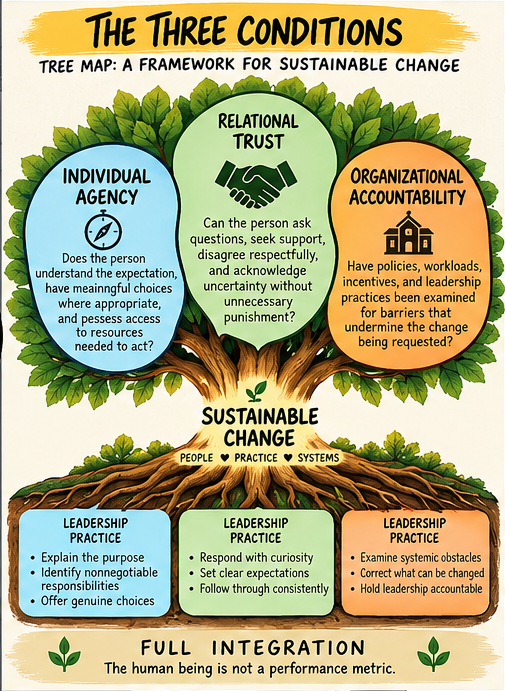
The Three Conditions: an original BRIAN Corps framework
1. Individual agency. People understand the purpose of an expectation and retain meaningful choice where choice is possible. Leaders distinguish essential duties from optional participation or private disclosure.
2. Relational trust. People can ask questions, report concerns, and disagree respectfully without needless humiliation. Leaders respond with curiosity, clarity, and follow-through.
3. Organizational accountability. Leaders examine workload, staffing, policies, incentives, access to support, and their own conduct. They do not assign every failure to an employee’s attitude.
These are practical design principles, not a validated diagnostic instrument. Their value must be tested in real settings rather than assumed.
When vulnerability becomes a performance
Imagine a professional development session where a facilitator asks teachers to publicly share a painful personal experience. One teacher declines. The facilitator presses. The room watches. Eventually the teacher shares.
Someone calls it a breakthrough. But compliance under social pressure is not proof of trust.
Offer alternatives: a fictional case, private reflection, voluntary discussion, or a simple right to pass. A principal’s voluntary disclosure is not equivalent to a principal asking employees to reveal theirs. Power changes the equation.
When coaching meets resistance
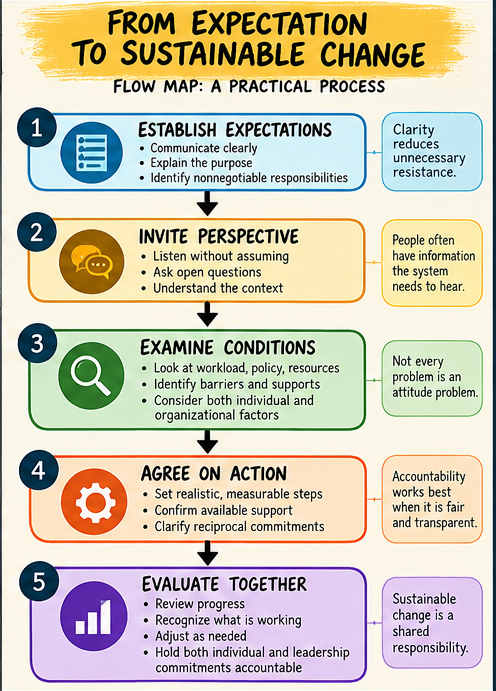
A teacher misses planning deadlines. The principal should identify the missed requirements and their impact, hear the teacher’s perspective, examine whether planning time and supports were available, agree on specific next steps, and revisit progress.
If reasonable expectations are still missed, performance accountability may be appropriate. If promised support never materialized, leadership has something to answer for too.
This is not lowering standards. It is refusing to make accountability a one-way street.
When rest is mistaken for disloyalty
Some schools reward the person who answers emails at night, volunteers for every committee, and is always available. That can celebrate commitment, but it can also reward exhaustion.
An educator who declines an optional task may be protecting time, health, family, or simple enjoyment. Refusal alone is not evidence of poor character. Evaluate the work and legitimate responsibilities, not how completely a person makes themselves available.
Full Integration: a whole person at work
Full Integration is a BRIAN Corps philosophy, not a clinical treatment or a research-validated theory. It recognizes that people can experience uncertainty and confidence, anger and care, grief and joy, without one emotion canceling another.
A teacher can challenge a policy and still care about the school. A leader can acknowledge a mistake and remain capable. A person can value recovery and decline to disclose their private history at work.
Rest is not automatically avoidance. Disagreement is not automatically defiance. And willingness is not obedience.
The sweetness is not pretending everything is fine. It is choosing how to respond while retaining the full humanity of the person making that choice.
Five questions for leaders
Before describing an educator as unwilling, ask:
1. Have we explained what must change and why?
2. Have we separated essential professional expectations from optional personal disclosure?
3. Have we offered realistic support and meaningful choices where appropriate?
4. Have we examined workload, trust, policy, and organizational barriers?
5. Are we prepared to evaluate our own follow-through as carefully as the employee’s?
These questions do not erase student safety, legal duties, or performance standards. They make our analysis more complete.
A different kind of invitation
Try opening a staff session this way: You are expected to engage professionally. You are not required to share private experiences. You can ask questions, challenge ideas respectfully, and request clarification. We will evaluate meaningful changes, not whether everyone looks enthusiastic. And leadership will be accountable for the conditions it controls.
That statement alone will not build trust. Consistent behavior might.
If we want educators to grow, we must stop treating their humanity as an obstacle to overcome.
You can invite change. You can support change. You can build the conditions for change. But you cannot demand authentic willingness and still call it freedom.
Bring the Sweetness. ✌🏾🖤💪🏾
About the author
Brian E. Johnson is an educator and organizational leadership practitioner with 25 years of experience. He founded BRIAN Corps LLC to connect education, coaching, storytelling, and preservation.
Research and attribution
[1] Slemp, G. R., Kern, M. L., Patrick, K. J., & Ryan, R. M. (2018). Leader autonomy support in the workplace: A meta-analytic review. Motivation and Emotion, 42, 706–724. https://doi.org/10.1007/s11031-018-9698-y
[2] Edmondson, A. (1999). Psychological safety and learning behavior in work teams. Administrative Science Quarterly, 44(2), 350–383. https://doi.org/10.2307/2666999
[3] World Health Organization. (2022). WHO guidelines on mental health at work. https://www.ncbi.nlm.nih.gov/books/NBK586381/
[4] RAND. (2025). To Make Teaching Sustainable, Help Teachers Balance Work and Personal Demands. https://doi.org/10.7249/RRA1108-20
[5] Steiner, E. D., Woo, A., & Doan, S. (2023). All Work and No Pay: Teachers’ Perceptions of Their Pay and Hours Worked. RAND. https://doi.org/10.7249/RRA1108-9
Inspiration (not research evidence): Dueñas, Jessica (October 18, 2026), “Yeah, I’m Not Doing That to Get Sober,” Bottomless to Sober. https://jessicaduenas.substack.com/p/yeah-im-not-doing-that-to-get-sober